Showing posts with label OROP. Show all posts

Friday, November 1, 2019

AFT: Pay military pensioners as per length of service

In a decision that will come as a major relief to military pensioners, the Armed Forces Tribunal (AFT) has ruled that the pension payable to such individuals should be calculated on the basis of actual length of service rendered by them, not as per the theoretical ‘maximum terms of engagement’ prescribed for their rank.
Allowing the petition of a 96-yrear-old IAF veteran, Master Warrant Officer Chander Bhan, the AFT’s Chandigarh Bench comprising Justice Virender Singh and Vice Admiral AG Thapliyal has ruled that the master policy of the Ministry of Defence (MoD), as approved by the Cabinet, is clear on the point that pension is now to be regulated as per the rank and length of service, irrespective of the date of retirement.
Bhan, who had joined the erstwhile Royal Indian Air Force in 1944 and was released from service in 1980, had contended that while he had served for 36 years, he was being paid the pension applicable to 28 years of service under the One Rank One Pension on the pretext that though he had served longer, the maximum terms of engagement mentioned in rules for his rank was only 28 years. Hence, in accordance with the implementation instructions issued by the MoD, pension was to be restricted as per maximum terms applicable for the rank held by a person at the time of retirement.
The Bench held that the implementation instructions could not pose any additional impediment since it would amount  to dividing pensioners based upon the maximum terms of engagement applicable at different dates of retirement. The Bench also observed that the earlier accepted recommendations of pay commissions had pegged pension to a maximum term of 33 years and the same could not be reduced through administrative instructions. It added that it was also arbitrary to pay pension for a lesser length of service when he was made to serve much longer.
Incidentally, this was the last judgment by Justice Virender Singh who retired this month after having served as the AFT chairperson. The AFT is currently functioning with only two judicial members against the sanctioned strength of 17. The remaining two members are scheduled to retire in December this year. Though the MoD has advertised vacancies, the appointments would be subject to the outcome of a case challenging AFT rules that is pending before the Supreme Court.

Courtesy: Tribune News Service, Chandigarh, October 30.

Wednesday, December 2, 2015

First The OROP, Now The 7th Pay Commission, When Will The Armed Forces Get Their Due?

By Kudrat Dutta Chaudhary: 

I wasn’t a keen follower of the OROP initially to be very honest, and stood at a moral ground of the rational apathetic until September. This is ironic because all the men in my family have served in the army and today I stand as a proud beneficiary of the same institution.

maitri dore one rank one pension indian army
Illustration by Maitri Dore

Why OROP Makes Sense
I remember as I enjoyed my rickshaw ride to the Ministry of External Affairs one day, the rickshaw puller got lost and took me to the Ministry of Home Affairs, the way to which crossed the Jantar Mantar. Being from Chandigarh, I had heard and read quite a lot about its significance and historical importance and how the monument till date stands for progressive thinking and an outlook towards a better future. Right in front and around the monument, I saw retired officers and soldiers, both old and young sweating yet standing tall, fighting for the rights of every man who pledges to serve our nation. There were so many of them with placards, many of their wives and children were present too, it was scorching hot and I wished that they’d be more comfortable, but then their resilience to their cause was a big enough reason for them to endure the roasting weather.

But my empathy, was interrupted with the thought that, those weren’t just ‘any men’ who’d crib at the slightest instance of being uncomfortable but rather those were the men some of who had served at the most severe temperatures, ranging from that at the Siachen Glacier to the dreary sands of the Thar desert to defend our country from forces, committed to ruffle the peace of it.

That was my moment of awakening and I developed a penchant towards the cause.
The demands were simple, One Rank One Pension, irrespective of one’s tenure, for a country that’s GDP has gone up in the recent past and a country where crores are embezzled over building states structures, it wasn’t an unfair cause, which the Indian soldiers were fighting for. In fact, the quest for implementing the OROP started with the promises that were made by the Government at power, before being elected. So the soldiers were just asking their due, in fact, their right that originated from the assurances given by the elected party at the centre.
But we have seen, how their commitment has been at a dilly-dally stance, where they have agreed to implement it but wouldn’t extend the provisions of the same to the officers who take premature retirement after 2013. Thus leaving the positive benefits of the wholesome implementation of the scheme in a limbo.

The Reality Of The 7th Pay Commission
Now let’s move on to the 7th Pay Commission, which to a layman would serve as an evidence of the fact that the government is doing way too much for the Indian Armed Forces. But I wish that was true. The Seventh Pay commission is a counter-incentive in the garb of a perfectly drafted report, providing the Indian Armed Forces with everything that they could ever imagine.

But this is far from true, to start with the Seventh Pay Commission has cancelled free ration in peace areas.
This is only the tip of the iceberg, the actual deal is this, the hardship allowance of an army officer has been fixed lower than that of a civil servant, which has always been the case. So if an army officer is posted in Siachen glacier, the highest battlefield of the world his hardship allowance would be 31,500 vis a vis an IAS officer’s hardship allowance which shall be around 70,000 for being in Jammu, which is a full-fledged area.

This has irked many in the forces, who expected a bridge of parity to be brought between civil servants and the forces. But because this inequality is perpetually maintained, it goes on to show how the ‘lal batti‘ is favoured more than the olive green uniform. In fact the 7th CPC’s bombshell recommendation, tucked away on Page 151, is that this relative advantage enjoyed by the IAS/IFS should be extended to the IPS and the Indian Forest Services, leaving the military out in the cold. Effectively, IAS, IPS and IFoS officers will get six additional increments by the time they complete 13 years of service. The military gets nothing, apparently in the continuing belief that its functions are not as complex, difficult and critical as the other four All India Services.

Maximum Risk, Minimum Gain
To many, the demands of the army officers have been irrational, some have called them greedy, but I ask you, would you ever do anything, anything at all if it required maximum risk and minimal gain? The businessmen might point the flaw in that question and state, “maximum risk goes with maximum gain.”

Now, what is this risk these army men withstand? Because to many, all they do is create destruction and go on raping women and misusing AFSPA.
I won’t spin yarns of praises of this institution because I have always felt that the working of the Indian Armed Forces was flawed at certain areas. But if there is anything at all for which the State is unprepared, be it the ghastly 26/11 attacks, or Prince slipping in a manhole or the floods that hit any State of our nation, or even relief operations, it is the army that is contacted. This is the same army, whose one-day salary is compulsorily cut if there are floods in Kashmir or an earthquake in Nepal.

They too wish that aman and shanti (peace and harmony) could exist and they too yearn that everyone got their own due and that everyone gets whatever they want.

For all that they do, I think they should be the highest paid, men should get incentives to join the armed forces. The number should go up and not come down. It is these men, whose due needs to be given and it is these men who are ensuring that you’re safely reading this.

Courtesy: Youth Ki Awaaz

Sunday, November 15, 2015

The OROP "Gift" Lowers Military Morale, National Security Compromised

Pradhan Mantri (PM) Modi celebrated Diwali with army troops at Dograi and reportedly announced that OROP was a Diwali gift to military veterans. Perhaps he was not aware that veterans are critical of this tainted “gift”, since it is a version of OROP seriously diluted by bureaucratic machinations. This includes a proviso that OROP benefit will not extend to soldiers who retire prematurely (PMR) in the future – “No-OROP-for-PMR”. Perhaps Mr.Modi does not know that troops would not have raised the PMR question because they are disciplined, but why he didn't himself tell veterans of his Diwali gift is not known.


The PM has never met veterans nor responded to their request for a meeting, though he has scored brownie points more than once when addressing serving soldiers regarding OROP. After assuring veterans of OROP during his election campaign, as PM Mr.Modi questioned the definition of OROP even though the Koshiyari Committee stated it explicitly. When he stated at Faridabad that he would transfer funds meant for the poor to meet the demand of funds for OROP, he effectively stated that veterans demand for OROP would be at the cost of the poor of India. Veterans see this as a slight and as a blatant attempt to gain political advantage, unbecoming of a PM from whom veterans and much of the country had great expectations.

Raksha Mantri (RM) Parrikar for his part, made several statements which have muddied the OROP waters already made murky by bureaucrats, and angered veterans. First he said that veterans should not expect 100% of their OROP demand. Then he said that India has not fought a war for decades, implying that soldiers need to hone their fighting skills and not bother about pay and pension. Most recently, he has gone to the extent of saying that veterans agitation and protest is “not soldier-like”. This is very much in keeping with the present government's practice of denigrating protests which oppose or criticize its policies, decisions or actions.

The Diwali 'gift'

Government's notification of OROP is a seriously diluted version of the concept of OROP on seven major counts. But the single most important issue which affects the demography of the military and consequent efficiency is the mischieviously introduced concept of premature retirement (PMR) as a means to deny OROP for veterans of the future, that is, today's serving soldier.

The effect of “No-OROP-for-PMR” is to encourage an “older” military which will be physically and motivationally less able to withstand the rigours of military service in the field. The numbers of disgruntled men and officers will increase as they stagnate in their rank and wait to reach the age of retirement in their rank, so as to not lose the benefit of OROP. Obviously, whenever possible, such soldiers will avoid hard training and diligent work. Disciplinary cases will multiply, and the negative loop will gain speed at the cost of preparedness for battle. Battles and wars cannot be fought, leave alone won, when the man-behind-the-gun is sullen, unhappy and demotivated due to the way his Service and his government treats him. The soldier who has taken an oath to fight for his country even at risk of death or disabling injury, will ask himself if he was mistaken.

The whole country was shocked at the police manhandling peacefully agitating veterans at Jantar Mantar on 14 August. From this pre-meditated humiliation by government, veterans understood that the government would surely prevaricate on the OROP demand, and their fears have come true. The veterans' peaceful and dignified agitation has crossed 150 days, and its leaders are increasingly hard put to control hotheads among them who are advising a more confrontational and aggressive approach. But what perhaps has irrevocably hardened the veterans' stance against the politician-bureaucrat nexus is PM Modi's treatment of veterans' decades-old demand of OROP as a Diwali 'gift'. Much worse, No-OROP-for-PMR has caused much discussion among serving soldiers of all ranks. They will remain silent because of the constraints of military law, but their disappointment and anger will inevitably translate into lowered morale and lowered battle efficiency, and compromising national security.

Civil-military relations

The seed of distrust of the politician-bureaucrat nexus among serving and retired faujis was sown and germinated during PM Manmohan Singh's watch. This seedling has been growing vigorously in the past year. The fact that the army's adjutant general has been meeting veterans in order to coax them to accept the diluted OROP formula, displays the supine attitude or worse, of the present top military leadership. Serving soldiers are critical of the equivocating role of their Service chiefs, who have effectively degraded the trust of subordinate ranks in the higher command structure.

The political class appears to remain ignorant of the organic link between military veterans and serving soldiers. What affects the soldier affects the veteran and vice versa, and today's soldier is tomorrow's veteran. Especially in the army, the largest of the armed forces, the Jawan and junior officer actually face the enemy, and in situations of extreme peril, rely entirely on mutual trust, team-work and training for individual survival and operational success. The morale of the fighting man is the glue that cements trust with team-work. Low morale spells botched operations, casualties, discipline problems and lost battles. The effect on serving soldiers of government's “gift” of OROP, is in the womb of time.

The PM, as executive head of government, needs to take responsibility for present nose-diving civil-military relations, which affect national security. This cannot be shrugged off as collective responsibility of the BJP as done for its Bihar defeat. But taking responsibility is one thing and doing something about it is another. With his post-Bihar vulnerability within his own party, PM Modi seems unlikely to do either.

National security

The deficiencies of equipment, weapons and ammunition from UPA days persists, with no improvement since May 2014. It is piquant that the deficiencies were boldly pointed out by then-COAS Gen V.K.Singh, the world knows how he paid for his “insolence”, and was driven into the arms of the BJP on retirement. Though he is a minister in the ruling dispensation, India's military capability remains degraded.

India's military has fought and won battles “fighting with what we have” (especially 1965 and Kargil 1999), because the morale of the soldier was high, and he placed value on his oath to defend and serve his country even at the risk of life and limb. India's military proved that with high morale and rigorous training, the man-behind-the-gun could compensate for lack of military materiel. But now, the morale situation worries anybody with concern for national security. Thus today, the nation's military suffers triple disadvantages, namely, failing trust in the political leadership, severe deficiencies in materiel, and lowered morale of the fighting man and his leaders.


The shenanigans of the politician-bureaucrat nexus regarding OROP adversely affecting the morale of India's armed forces will be appreciated if not celebrated with crackers by Pakistan's military. The strategically ignorant, chronically myopic, blatantly arrogant politician-bureaucrat nexus has irreversibly harmed India by harming its own armed forces. India's political sovereignty and territorial integrity are at risk, as governments' last bastion for both domestic governance and external security is being knowingly or unknowingly emasculated. PM Modi has much to think about.

Major General S.G. Vombatkere, VSM, retired in 1996 as Additional DG Discipline & Vigilance in Army HQ AG's Branch. He holds a PhD degree in Structural Dynamics from I.I.T, Madras. He is Adjunct Associate Professor of the University of Iowa, USA, in international studies. With over 450 published papers in national and international journals and seminars, his current area of interest is strategic and development-related issues. E-mail: sg9kere@live.com

Monday, November 9, 2015

The Ministry of Defence Letter granting One Rank One Pension (OROP) has been issued. The same can be downloaded and accessed by clicking here.

Saturday, November 7, 2015

One Rank One Pension (OROP) notified

Salient features of OROP notified today:
Pensions based on live data of 2013 calculated at average of minimum and maximum pensions of individuals who were discharged in the said year. Pensions shall be equalized every 5 years.
If any person is in receipt of pension higher than the above amount, that shall stay protected. Pensioners with lower amount shall be upgraded.
Arrears with effect from 01 July 2014, to be paid in four installments but recipients of family pension shall be released arrears in one installment. Gallantry awardees also to be paid in one single installment.
Voluntary retirement clause removed for all past retirees but the negative stipulation shall be imposed on future retirees who opt for premature retirement or discharge at own request from today onwards. This shall apply to those who opt for release under Rule 13(3)1(i)(b),13(3)1(iv) or 16B of the Army Rules 1954 and pari materia rules of the other two services.
Judicial Commission will be constituted to iron out the anomalies which shall submit its report in 6 months.
OROP tables based on 2013 data shall be made available very soon.

Courtesy: Major Navdeep Singh

Saturday, October 3, 2015

The Dimensions of Veterans’ Disillusionment and Ire

By: Major General S. G. Vombatkere
Mainstream, 28 September 2015

The Government of India (GoI) finally announced its version of One-Rank-One-Pension (OROP) for military Veterans. This was welcomed only in part by the Veterans, because there were important sticking points which were not included or inadequately included in the announcement. Fortunately, the Veterans who were on fast-unto-death were persuaded to end their fast, but the Veterans’ resolve to remain on protest until the outstanding points were settled to their satisfaction, resulted in planning a “Sainik Ekta Rally” on September 12 at New Delhi’s Jantar Mantar.

But reverting to the GoI’s OROP announce-ment, obviously at the instance of the bureau-cracy, it included a hitherto unmentioned stipulation that soldiers who opt for VRS (voluntary retirement scheme) would not be entitled to OROP. When the GoI was informed that there was no concept of VRS in the defence services, the same stipulation was shifted to soldiers who took premature retirement. This has angered Veterans because many soldiers take premature retirement since promotion avenues are severely limited, or because there are problems in distant homes, or they try their luck at some job in civvy street since there is no job assurance on retirement anyway. Today, Veterans are waiting for the GoI’s signed document on OROP since they have been repeatedly cheated and have long since ceased to trust the spoken word of politicians and bureaucrats.

Ekta Rally

It is learned that the GoI had “advised” Veterans not to hold the “Ekta Rally”. But the rally on September 12 was a huge success, with thousands of Veterans from all over India converging at Jantar Mantar, exceeding the expectations of the organisers. When TV crews present were asked as to why the rally was not being screened, on condition of anonymity they revealed that the GoI had “advised” the TV channel managements not to air the event. It has also come to light that buses crammed with Veterans were stopped at the Delhi border to deter Veterans (all old and many infirm) from reaching Jantar Mantar.

It is abundantly clear that the GoI has tried, unsuccessfully as it turned out, to make the “Ekta Rally” fail. But Veterans, even some in wheel-chairs, have spoken with their feet; the discomfiture of the GoI is complete. One Veteran even asked whether the GoI’s strategem of breaking the Veterans’ unity was a harbinger of the days to come. Serious rumblings! And what would be the thoughts of the serving soldier on his cold vigil on the Himalayan and trans-Himalayan heights?

The World Watches

It has already been brought out how apex-scale-pension retired bureaucrat Avay Shukla’s article titled “The Bitter Truth About OROP”, in which he argued that OROP is “inherently flawed”, “cannot be limited to the armed forces only”, and is “neither fair nor possible”, was being gleefully discussed in “Pakistan Defence”. <http://defence.pk/threads/the-bitte...> The whole world, and especially India’s neighbours, are well aware that the GoI’s intransigence on the OROP issue is affecting the morale of the serving soldier who guards our frontiers. However, the GoI, under the thrall of an obstinately self-serving and strategically myopic civil service, appears to be oblivious to the rapidly worsening situation. It has escaped nobody’s attention that PM Narendra Modi, ordinarily a self-confident and loquacious person, has not spoken with Veterans since the agitation began, and speculation of the reason is rife. The unfortunate gap in civil-military relations having widened to a chasm is apparent.

The Veterans’ agitation at Jantar Mantar, starting on June 14, 2015, moving on to relay fast and finally some Veterans undertaking fast-unto-death to force the hand of the GoI to announce OROP, is undoubtedly being watched by intelligence agencies worldwide, and especially by Pakistan and China. Its effect on serving soldiers would inevitably be carefully assessed.
Military Capability
It is well to note that the weapons, ammunition and equipment deficiencies—which were revealed by the then Army Chief, Gen V.K. Singh, to the consternation and annoyance of the UPA Government—have not yet been made up. It is not known whether the National Security Council (NSC) has consulted Gen V.K. Singh, since retired, who is a Union Minister in the present GoI, on this critical issue.

It is wisely said that the quality of the man-behind-the-gun is at least as important as the availability and quality of the gun itself. Indeed, the GoI is commemorating 50 years of the 1965 war against Pakistan, during which Pakistan’s designs were soundly defeated by motivated Indian soldiers using dated arms and equipment pitted against Pakistan’s superior Patton tanks and F-86 Sabre jet aircraft gifted by the USA. But today, 50 years later, the man-behind-the-gun is unhappy due to persistent injustices and indignities heaped upon him over the decades by the bureaucrat-politician nexus. And India’s military capability is further degraded by shor-tages of weapons, ammunition and equipment.

Joining the Dots

It is for the NSC to consider whether the increase in ceasefire and LOC violations by Pakistan, and the Pakistan Army Chief’s belligerent statements, are actually Pakistan testing India’s political will and military capability.

It must be recalled that soon after Narendra Modi assumed office as the PM, he sat cordially with Chinese President Xi Ping on a “jhoola” on the banks of the Sabarmati. At that very time, Chinese troops had made incursions near Depsang-la across the LAC in Ladakh. Today, on September 12, the ominous breaking news is that Chinese workers have started constructing permanent defences near Burtse (not far from Depsang-la), and when the Indian troops objected, Chinese troops have moved in.

One must recall that the attack by China in 1962 began in October, the month when Indian troops begin to experience increasing mobility difficulties in the Himalayan terrain as winter progresses, while Chinese troops have little or no such mobility constraints and are today further advantaged by firm logistics of the railway link to Lhasa. In 1962, as now, India’s soldier was ill-equipped and there was a huge gap in civil-military relations. But today the situation also includes a sense of disillusionment among the serving soldiers, which did not obtain in 1962.

PM Modi, and the NSC which he heads, may have to think and act very quickly to assess the real-time joint Pakistan-China threat. In any case, they would do well to urgently create a single-point-of-military-advice by appointing a military officer as the National Security Advisor (as NSA-External) in addition to the existing NSA who would advise on internal security. This writer hopes and prays that his apprehen-sions of external threat are unfounded.

Major General S.G. Vombatkere, VSM, retired in 1996 as the Additional DG Discipline and Vigilance in the Army HQ AG’s Branch. He holds a Ph.D degree in Structural Dynamics from IIT Madras. He is the Adjunct Associate Professor of the University of Iowa, USA, in international studies. With over 450 published papers in national and international journals and seminars, his current area of interest is strategic and development-related issues.

Sunday, September 6, 2015

OROP Rolled Out, But Veterans Want More


Fulfilling one of its major election promises in the run up to the Lok Sabha elections of the BJP, Defence Minister Manohar Parrikar on Saturday announced the implementation of the long delayed One Rank One Pension (OROP) for ex-servicemen.

The avowed aim of this announcement, to end the strike by veterans demanding OROP was however hanging in fire with protesting veterans rejecting the “unilateral” announcement as it “dilutes” several core issues from the accepted definition. In an effort to get the veterans on board, Mr. Parrikar met representatives of ex-servicemen later in the day and some understanding has been reached.

“Despite the huge fiscal burden, given its commitment to the welfare of ex-servicemen, the government has taken a decision to implement the OROP,” Mr. Parrikar while announcing the plan, and said the ministry of defence would soon issue a detailed government order.

Government's Offer
What veterans want
Effective from July 1, 2014
April 1, 2014
OROP will be average of minimum and maximum pension scale in 2013
Base for pension should be maximum of the pension scale in 2013
Revision every 5 years
One or two years
One-member judicial commission to submit report in six months
Five-member team under Defense Minister to submit report in one month


Mr. Parrikar said 2013 would be taken as the base year for calculation and it would be implemented from July 1, 2014 the earliest date after the government assumed office. Equalisation of pensions would be done every five years as against the usual practice of once a decade. As per definition OROP implies uniform pension be paid to the armed forces personnel retiring in the same rank and length of service regardless of their date of retirement.

“Under this definition, it has been decided that the gap between rate of pension of current pensioners and past pensioners will be bridged every five years,” Mr. Parrikar said. This has been the key issue of disagreement between the government and the veterans who wanted annual revision in line with the definition. Arrears would be paid in half-yearly instalments, however, all widows would be paid in one instalment.

Another hitch

While OROP would be applicable for the disabled and war widows, those opting for voluntary retirement and not complementing full service will be out of its ambit. This has raised a new point of disagreement between the veterans and the government. Mr. Parrikar said the government would give details on the voluntary retirement in the government order. Asked if the decision would be acceptable to the veterans, Mr. Parrikar said, “I want the veterans on board on all issues”.

After meeting Mr. Parrikar, Major Gen Singh expressed satisfaction on the explanation by the government on the issue of VRS. “Premature retirement is the one point we wanted to discuss. Defence Minister confirmed that Army doesn’t have VRS,”he said. On future course of action he said they would take a decision on the agitation after “discussing with the core group”.

Veterans react

Responding to the statement, ex-servicemen while thanking the government for implementing the scheme rejected the modalities. They have been demanding an annual revision and implementation from April 1, 2014. “The government has taken a decision, this is what we can give,” added Minister of State for Defence, Rao Inderjit Singh.

To address complexities and sort out inter-services issues the government will appoint a one member judicial commission which will give its report within six months. The veterans in turn demanded a five member directly under the Defence Minister and the report submitted within one month.

Given details on the cost of OROP to the exchequer, Mr. Parrikar stated that it would cost between Rs. 8,000-10,000 crore at present which would increase in future. The expenditure on arrears alone would be Rs. 12,000 crore. Currently the pension bill of the defence ministry stands at Rs. 54,000 crore.

There are about 2.45 million veterans and six lakh war widows who stand to benefit from the scheme.

All about OROP:

1
Defence Minister Manohar Parrikar announced thedecision to implement the One Rank One Pension, w.e.f July 1, 2014.

2
OROP arrears to be paid in four half-yearly instalments; all widows, including war widows, to be paid arrears in one instalment.

3
The ex-servicemen, who have been agitating for the last 82 days, said they will not accept review of the pension after every five years.

4
It is understood that a draft proposal on OROP was circulated at a RSS meeting on Friday, which envisaged commencement of the scheme from July 2014, besides revision of pension every five years.

5
Veterans have opposed to excluding ex-servicemen, who had opted for pre-mature retirement, from the ambit of OROP.

6
Defence Minister Manohar Parrikar announced the setting up of a One member Judicial Committee, which will give its report on OROP in six months.

7
Veterans have rejected this committee, and instead demanded a committee under the Defence Minister which will include an ex-serviceman too.

8
To begin with, OROP would be fixed on the basis of calender year 2013.

9
Officials said the annual burden on the pension bill will be about Rs. 8,000 crore which would progressively go up with revision in pensions. The current pension bill of the defence ministry stands at Rs. 54,000 crore.

10
Close to 22 lakh retired servicemen and over six lakh war widows stand to be the immediate beneficiaries of the scheme.


 Source: The Hindu

Sunday, August 2, 2015

Universal orders issued for revision of enhanced pension from 01-01-2006 rather than 24-09-2012

Following the decision of the Armed Forces Tribunal and the Central Administrative Tribunal, as upheld by a judgement of the Delhi High Court (which in turn was based upon a decision of the Punjab & Haryana High Court) and then endorsed by the Supreme Court, and further after various twists and turns, the Department of Pension and Pensioners’ Welfare (DoPPW) has finally issued universal orders regarding revision of pension of pre-2006 pensioners with effect from 01 Jan 2006 rather than 24 Sept 2012.

All affected pensioners (and not just litigants) shall now be eligible for arrears from 01-01-2006 till 23-09-2012.


Thursday, July 2, 2015

Delay in OROP implementation could affect morale of soldiers

The fast for justice being held by India’s ex-servicemen at Jantar Mantar in New Delhi and in over 50 other cities has now entered its third week. The protesting veterans are demanding the rollout of the One Rank One Pension (OROP) scheme, which has not been honoured by successive governments.
The quest of the veterans for OROP, a term coined by a Parliamentary committee headed by KP Singh Deo in 1983, goes back several decades. In 1973, while implementing the recommendations of the Third Pay Commission, the government reduced the pensions of armed forces personnel from 73% of the last pay drawn to 50%.
The concept of ‘military pension’, designed to provide monetary compensation for truncated service due to early retirement, was diluted. Soldiers, sailors and airmen opt to retire between 35 and 37 years of age when most of their family responsibilities are still ahead of them, while most of the officers retire at the age of 54.
Despite their discipline, dedication and talent, they find it difficult to get jobs.
Personnel in the Central Armed Police Forces (CAPFs) like the BSF, CRPF, ITBP, CISF, SSB and the state police retire between the ages of 57 and 60 years. The Fifth Pay Commission had recommended that armed forces personnel be laterally transferred to the CAPFs after five to seven years of service.
This would enable the armed forces to maintain a young profile and reduce the pension bill of the government. However, the government of the day lacks the political will to push through this win-win measure.
Officers of the CAPFs and all other civilian officers (IAS, IFS, IPS, IRS) retire at the age of 60 years, while only 0.84% of armed forces officers make it to the rank of major general, who retire at 58. A still smaller number are lieutenant general and retire at 60. Incidentally, every IAS officer is routinely promoted to the position of joint secretary, considered equal to a major general. 
The national consensus favours the implementation of OROP for the armed forces. The Congress-led UPA government gave a commitment to implement OROP and even allotted a sum of Rs 500 crore in the interim budget for FY 2014-15. Union finance minister Arun Jaitley doubled it to Rs1,000 crore when he presented the budget in July 2014.
Prime Minister Narendra Modi unequivocally promised to implement OROP while addressing the veterans at an election rally at Rewari in September 2013. However, in a surprise to 25 lakh veterans and three lakh widows, the prime minister recently said that it was a “complex” issue and that there were several definitions of OROP.
Veterans, however, agree to an unambiguous definition of OROP. In February 2014, the following definition of OROP was approved in a meeting chaired by the defence minister: “OROP implies that uniform pension be paid to the armed forces personnel retiring in the same rank with the same length of service, irrespective of their date of retirement and any future enhancement in the rates of pension be automatically passed on to the past pensioners.”
The recommendations made by the defence minister, in consultation with the chiefs of the armed forces and the veterans, are reportedly being opposed by the finance ministry on the grounds that the annual cost of Rs8,400 crore is unaffordable and that a similar demand may spring from the CAPFs. It appears that the issue might be referred to the Seventh Pay Commission for a ‘holistic’ overview.
 
Often, the personnel in CAPFs serve much longer than the ones in the armed forces, which means that they earn more increments and therefore must not be equated for pension. The additional expenditure on OROP is less than 10% of the pension bill of Rs88,521 crore for 2015-16, which is much less than other subsidies. 

Hence, the recommendation of referring the issue to the Seventh Pay Commission is seen as an insidious plot to scuttle the OROP scheme.

Civil-military relations in India have a troubled past and any attempt to indefinitely delay a long-pending welfare measure will only aggravate the situation.
As it is, the serving and retired members of the armed forces feel wronged at having been deprived of their dues in several cases in the past, including the ‘rank pay’ case, 36 pending anomalies in the implementation of the awards of the Fifth and the Sixth Pay Commissions, and the withholding of non-functional upgradation (NFU) of pay for officers denied promotion for lack of vacancies. 

Also, the ministry of defence has repeatedly appealed against the court judgements that favour the veterans and soldiers’ widows — often contesting that the award of paltry sums, even as the cost of litigation exceeds the amount at stake.

The government must take note of the impact of the prolonged delay in the implementation of OROP on morale — not only of the veterans, but also of the serving soldiers; it may also affect many second or third generation soldiers who are witness to the sad plight of those before them. 

The day a soldier takes his oath, he undertakes to selflessly serve his nation and even make the supreme sacrifice when necessary. He swears allegiance to Naam, Namak, Nishan and has never faltered.

In turn, the nation’s covenant is that no effort will be spared to look after his welfare and that of his family. Addressing the United States servicemen some years ago, US President Barack Obama said, “…when you take off the uniform, we will serve you as well as you’ve served us — because no one who fights for this country should have to fight for a job, or a roof over their heads, or the care that they need when they come home.”
Indian veterans also need to be given a similar assurance, but one that is credible.   
Gurmeet Kanwal is an army veteran and a Delhi-based strategic analyst 
(The views expressed are personal)

Source: Hindustan Times

Thursday, June 25, 2015

They Dedicate Their Lives To Protect Ours, Then Why Aren’t Their Demands Being Heard? - By Arati Nair

The famous American military leader, General Douglas MacArthur once said, “Old soldiers do not die, they just fade away.” He borrowed it from a song popular among British soldiers during World War I. Quoting this bit of trivia from an ugly period of the world’s military history is significant as it rings true even today. A case in point is the ongoing turbulence surrounding the implementation of the One Rank One Pension (OROP) scheme in India.

After a prolonged period of inertia, the retired personnel from the armed forces have renewed their protests, including hunger strikes, against the delay in implementing the OROP. Last week, various organizations of ex-servicemen initiated nation-wide protests, including in the national capital, following the failure of talks with the government. The main bone of contention for these groups is the reluctance of the authorities to provide a time-frame for implementation of the scheme. The issue is being shuttled between the defence ministry (MoD) and the ministry of finance, which has further irked veteran soldiers throughout the country. That a poll promise of the BJP has now seemingly become a question of political largesse, has not gone down well either.
Why Are The Veterans Demanding OROP?
One Rank One Pension provides for the same pension for the same length of service by personnel of the same rank, irrespective of the date of retirement. Any increments in pension rates are to be added onto the past pensioners’ pay as well. This definition was accepted by the last committee to deliberate on the issue, the Koshyari Committee (2011). It will benefit over 20 lakh ex-servicemen and about six lakh war widows. In essence, this scheme, if implemented, would not discriminate among veterans, war widows etc. on the pesky premise of retirement date.
In this context, the organizers of the nation-wide war cry for the OROP have faced the brunt of numerous problems and justify their demands on several counts, like lack of parity with the civil services, inequity with the paramilitary forces and superseding powers of the bureaucracy.
What’s The Tiff With The Bureaucracy?
The OROP, axed in 1973 during the authoritarian Indira regime to equalize civil and military pay, is hardly a new concept. Most of the dilly-dallying, as alleged by various organizations of ex-servicemen partaking in the demonstrations, can be attributed to the bureaucracy dragging its feet in this regard.
The non-functional upgrade (NFU) granted to the officers in all-India Group A services (IAS, IPS etc.) by the sixth Central Pay Commission (CPC) allows them higher pay than permissible for their rank during ‘certain’ conditions. This couteous gesture is limited to the bureaucracy, with no such additional aid being extended to the defence forces. Glaring disparities in field allowances of army special forces as against paramilitary commandos betrays the step-motherly attitude of the government towards the former. With limited prospects for career growth when compared to their contemporaries in the civil services, defence personnel deem themselves entitled for a hike in pay/pension to bridge the gap.
Even as the stalemate over OROP continues, the veterans accuse the civil servants of covertly sabotaging their efforts. This includes attempts to dilute the definition of the scheme and even suggesting alternative models such as the one proposed by the departments of the MoD, which seeks to implement OROP for those pensioners who retired prior to 2006.
This exercise has been been dubbed as a design by the bureaucratic machinery to scale down the demands of ex-servicemen, and exercise its one-upmanship over the military.
Why Aren’t Politicos Listening?
The politicians are equally culpable for the present scenario. A Supreme Court judgement, providing suffrage rights to serving defence personnel in their area of posting, compelled all political parties to extend piecemeal offers to appease them. The present government, in particular, vociferously supported the implementation of the OROP and its benevolence for the armed forces was evident by the appointment of ex-army officials like General V.K. Singh and Colonel Rajyavardhan Singh Rathore to key positions in various ministries. But when General V.K. Singh says- “The Prime Minister has made a promise regarding OROP. It will be implemented. There is some delay because calculations are going on. Therefore it is taking time“, he is reiterating the government’s position with little substantive effort to echo the sentiments of his defence brethren.
Road Ahead
The initial fervour now seems lacking, with the centre working on a fresh draft governmental letter (DGL) as opposed to the one forwarded by the defence services headquarters. Thus, the accepted definition of OROP is bound to be tinkered with.
A highly disciplined section of our population had to take to the streets and sign petitions in blood in a mad dash attempt to jolt the authorities into action. The government, hiding behind technicalities, has propped feeble excuses like fund scarcity and inter-ministerial discord as its armour against the wrath of these betrayed citizens. The protesters, in their desperation, are even willing to set aside their pathological disagreement with the opposition and seek help from the Congress.
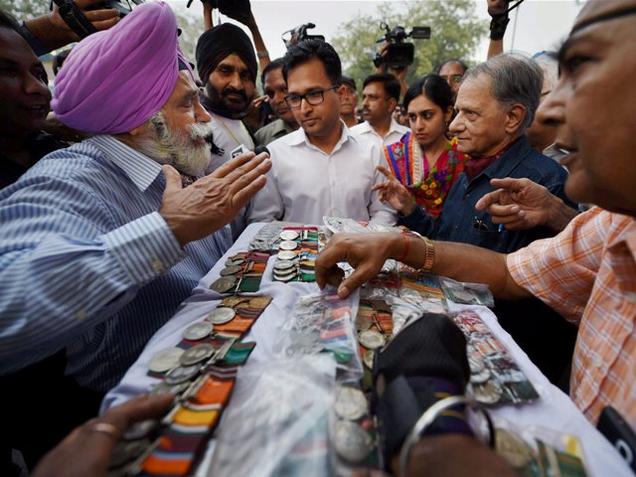
Relinquishing medals did not awaken the last government. War veterans like Havildar Kaka Singh (retd.), rendered blind during the 1965 Indo-Pak war, are still lying in wait for the leadership of the country to consider their plight. Thisscathing open letter by Honorary Lieutenant Kameshwar Pandey conveys the despondence slowly pervading our fauji ranks. It remains to be seen if the country-wide protests will yield any results. Or will our old soldiers, as is the universal case, simply fade away?