Pradhan
Mantri (PM) Modi celebrated Diwali with army troops at Dograi and reportedly
announced that OROP was a Diwali gift to military veterans. Perhaps he was not
aware that veterans are critical of this tainted “gift”, since it is a version
of OROP seriously diluted by bureaucratic machinations. This includes a proviso
that OROP benefit will not extend to soldiers who retire prematurely (PMR) in
the future – “No-OROP-for-PMR”. Perhaps Mr.Modi does not know that troops would
not have raised the PMR question because they are disciplined, but why he
didn't himself tell veterans of his Diwali gift is not known.
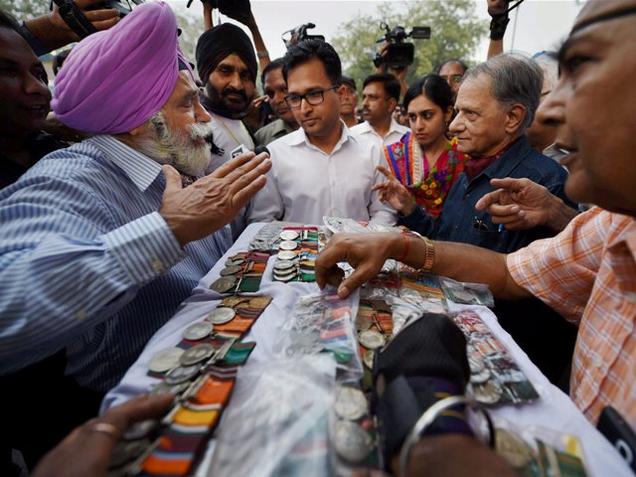
The PM has never met
veterans nor responded to their request for a meeting, though he has scored
brownie points more than once when addressing serving soldiers regarding OROP.
After assuring veterans of OROP during his election campaign, as PM Mr.Modi
questioned the definition of OROP even though the Koshiyari Committee stated it
explicitly. When he stated at Faridabad that he would transfer funds meant for
the poor to meet the demand of funds for OROP, he effectively stated that
veterans demand for OROP would be at the cost of the poor of India. Veterans see
this as a slight and as a blatant attempt to gain political advantage,
unbecoming of a PM from whom veterans and much of the country had great
expectations.
Raksha Mantri (RM)
Parrikar for his part, made several statements which have muddied the OROP waters
already made murky by bureaucrats, and angered veterans. First he said that
veterans should not expect 100% of their OROP demand. Then he said that India
has not fought a war for decades, implying that soldiers need to hone their
fighting skills and not bother about pay and pension. Most recently, he has
gone to the extent of saying that veterans agitation and protest is “not
soldier-like”. This is very much in keeping with the present government's
practice of denigrating protests which oppose or criticize its policies,
decisions or actions.
The Diwali 'gift'
Government's
notification of OROP is a seriously diluted version of the concept of OROP on
seven major counts. But the single most important issue which affects the
demography of the military and consequent efficiency is the mischieviously
introduced concept of premature retirement (PMR) as a means to deny OROP for
veterans of the future, that is, today's serving soldier.
The effect of
“No-OROP-for-PMR” is to encourage an “older” military which will be physically
and motivationally less able to withstand the rigours of military service in
the field. The numbers of disgruntled men and officers will increase as they
stagnate in their rank and wait to reach the age of retirement in their rank,
so as to not lose the benefit of OROP. Obviously, whenever possible, such
soldiers will avoid hard training and diligent work. Disciplinary cases will
multiply, and the negative loop will gain speed at the cost of preparedness for
battle. Battles and wars cannot be fought, leave alone won, when the
man-behind-the-gun is sullen, unhappy and demotivated due to the way his
Service and his government treats him. The soldier who has taken an oath to
fight for his country even at risk of death or disabling injury, will ask
himself if he was mistaken.
The whole country was
shocked at the police manhandling peacefully agitating veterans at Jantar
Mantar on 14 August. From this pre-meditated humiliation by government,
veterans understood that the government would surely prevaricate on the OROP
demand, and their fears have come true. The veterans' peaceful and dignified
agitation has crossed 150 days, and its leaders are increasingly hard put to
control hotheads among them who are advising a more confrontational and
aggressive approach. But what perhaps has irrevocably hardened the veterans'
stance against the politician-bureaucrat nexus is PM Modi's treatment of
veterans' decades-old demand of OROP as a Diwali 'gift'. Much worse,
No-OROP-for-PMR has caused much discussion among serving soldiers of all ranks.
They will remain silent because of the constraints of military law, but their
disappointment and anger will inevitably translate into lowered morale and
lowered battle efficiency, and compromising national security.
Civil-military
relations
The seed of distrust of
the politician-bureaucrat nexus among serving and retired faujis was sown and
germinated during PM Manmohan Singh's watch. This seedling has been growing
vigorously in the past year. The fact that the army's adjutant general has been
meeting veterans in order to coax them to accept the diluted OROP formula,
displays the supine attitude or worse, of the present top military leadership.
Serving soldiers are critical of the equivocating role of their Service chiefs,
who have effectively degraded the trust of subordinate ranks in the higher
command structure.
The political class
appears to remain ignorant of the organic link between military veterans and
serving soldiers. What affects the soldier affects the veteran and vice versa,
and today's soldier is tomorrow's veteran. Especially in the army, the largest
of the armed forces, the Jawan and junior officer actually face the enemy, and
in situations of extreme peril, rely entirely on mutual trust, team-work and
training for individual survival and operational success. The morale of the
fighting man is the glue that cements trust with team-work. Low morale spells
botched operations, casualties, discipline problems and lost battles. The
effect on serving soldiers of government's “gift” of OROP, is in the womb of
time.
The PM, as executive
head of government, needs to take responsibility for present nose-diving
civil-military relations, which affect national security. This cannot be
shrugged off as collective responsibility of the BJP as done for its Bihar
defeat. But taking responsibility is one thing and doing something about it is
another. With his post-Bihar vulnerability within his own party, PM Modi seems
unlikely to do either.
National security
The deficiencies of
equipment, weapons and ammunition from UPA days persists, with no improvement
since May 2014. It is piquant that the deficiencies were boldly pointed out by
then-COAS Gen V.K.Singh, the world knows how he paid for his “insolence”, and
was driven into the arms of the BJP on retirement. Though he is a minister in
the ruling dispensation, India's military capability remains degraded.
India's military has
fought and won battles “fighting with what we have” (especially 1965 and Kargil
1999), because the morale of the soldier was high, and he placed value on his
oath to defend and serve his country even at the risk of life and limb. India's
military proved that with high morale and rigorous training, the
man-behind-the-gun could compensate for lack of military materiel. But now, the
morale situation worries anybody with concern for national security. Thus
today, the nation's military suffers triple disadvantages, namely, failing
trust in the political leadership, severe deficiencies in materiel, and lowered
morale of the fighting man and his leaders.
The shenanigans of the
politician-bureaucrat nexus regarding OROP adversely affecting the morale of
India's armed forces will be appreciated if not celebrated with crackers by
Pakistan's military. The strategically ignorant, chronically myopic, blatantly
arrogant politician-bureaucrat nexus has irreversibly harmed India by harming
its own armed forces. India's political sovereignty and territorial integrity
are at risk, as governments' last bastion for both domestic governance and
external security is being knowingly or unknowingly emasculated. PM Modi has
much to think about.
Major General S.G. Vombatkere, VSM, retired in 1996 as Additional DG Discipline & Vigilance in Army HQ AG's Branch. He holds a PhD degree in Structural Dynamics from I.I.T, Madras. He is Adjunct Associate Professor of the University of Iowa, USA, in international studies. With over 450 published papers in national and international journals and seminars, his current area of interest is strategic and development-related issues. E-mail: sg9kere@live.com
Major General S.G. Vombatkere, VSM, retired in 1996 as Additional DG Discipline & Vigilance in Army HQ AG's Branch. He holds a PhD degree in Structural Dynamics from I.I.T, Madras. He is Adjunct Associate Professor of the University of Iowa, USA, in international studies. With over 450 published papers in national and international journals and seminars, his current area of interest is strategic and development-related issues. E-mail: sg9kere@live.com


