Wednesday, December 2, 2015

First The OROP, Now The 7th Pay Commission, When Will The Armed Forces Get Their Due?

By Kudrat Dutta Chaudhary: 

I wasn’t a keen follower of the OROP initially to be very honest, and stood at a moral ground of the rational apathetic until September. This is ironic because all the men in my family have served in the army and today I stand as a proud beneficiary of the same institution.

maitri dore one rank one pension indian army
Illustration by Maitri Dore

Why OROP Makes Sense
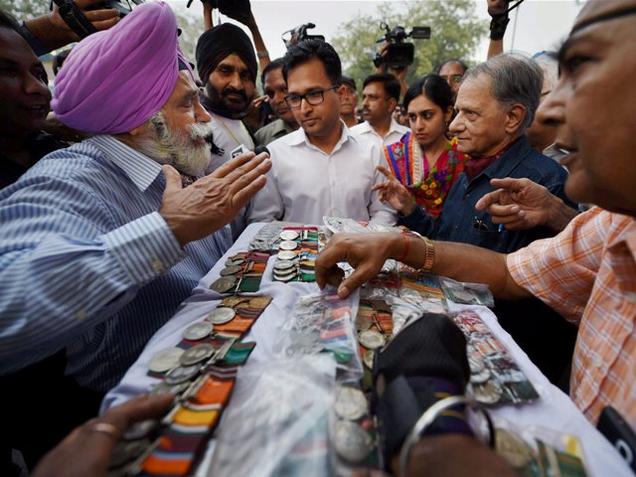
I remember as I enjoyed my rickshaw ride to the Ministry of External Affairs one day, the rickshaw puller got lost and took me to the Ministry of Home Affairs, the way to which crossed the Jantar Mantar. Being from Chandigarh, I had heard and read quite a lot about its significance and historical importance and how the monument till date stands for progressive thinking and an outlook towards a better future. Right in front and around the monument, I saw retired officers and soldiers, both old and young sweating yet standing tall, fighting for the rights of every man who pledges to serve our nation. There were so many of them with placards, many of their wives and children were present too, it was scorching hot and I wished that they’d be more comfortable, but then their resilience to their cause was a big enough reason for them to endure the roasting weather.

But my empathy, was interrupted with the thought that, those weren’t just ‘any men’ who’d crib at the slightest instance of being uncomfortable but rather those were the men some of who had served at the most severe temperatures, ranging from that at the Siachen Glacier to the dreary sands of the Thar desert to defend our country from forces, committed to ruffle the peace of it.

That was my moment of awakening and I developed a penchant towards the cause.
The demands were simple, One Rank One Pension, irrespective of one’s tenure, for a country that’s GDP has gone up in the recent past and a country where crores are embezzled over building states structures, it wasn’t an unfair cause, which the Indian soldiers were fighting for. In fact, the quest for implementing the OROP started with the promises that were made by the Government at power, before being elected. So the soldiers were just asking their due, in fact, their right that originated from the assurances given by the elected party at the centre.
But we have seen, how their commitment has been at a dilly-dally stance, where they have agreed to implement it but wouldn’t extend the provisions of the same to the officers who take premature retirement after 2013. Thus leaving the positive benefits of the wholesome implementation of the scheme in a limbo.

The Reality Of The 7th Pay Commission
Now let’s move on to the 7th Pay Commission, which to a layman would serve as an evidence of the fact that the government is doing way too much for the Indian Armed Forces. But I wish that was true. The Seventh Pay commission is a counter-incentive in the garb of a perfectly drafted report, providing the Indian Armed Forces with everything that they could ever imagine.

But this is far from true, to start with the Seventh Pay Commission has cancelled free ration in peace areas.
This is only the tip of the iceberg, the actual deal is this, the hardship allowance of an army officer has been fixed lower than that of a civil servant, which has always been the case. So if an army officer is posted in Siachen glacier, the highest battlefield of the world his hardship allowance would be 31,500 vis a vis an IAS officer’s hardship allowance which shall be around 70,000 for being in Jammu, which is a full-fledged area.

This has irked many in the forces, who expected a bridge of parity to be brought between civil servants and the forces. But because this inequality is perpetually maintained, it goes on to show how the ‘lal batti‘ is favoured more than the olive green uniform. In fact the 7th CPC’s bombshell recommendation, tucked away on Page 151, is that this relative advantage enjoyed by the IAS/IFS should be extended to the IPS and the Indian Forest Services, leaving the military out in the cold. Effectively, IAS, IPS and IFoS officers will get six additional increments by the time they complete 13 years of service. The military gets nothing, apparently in the continuing belief that its functions are not as complex, difficult and critical as the other four All India Services.

Maximum Risk, Minimum Gain
To many, the demands of the army officers have been irrational, some have called them greedy, but I ask you, would you ever do anything, anything at all if it required maximum risk and minimal gain? The businessmen might point the flaw in that question and state, “maximum risk goes with maximum gain.”

Now, what is this risk these army men withstand? Because to many, all they do is create destruction and go on raping women and misusing AFSPA.
I won’t spin yarns of praises of this institution because I have always felt that the working of the Indian Armed Forces was flawed at certain areas. But if there is anything at all for which the State is unprepared, be it the ghastly 26/11 attacks, or Prince slipping in a manhole or the floods that hit any State of our nation, or even relief operations, it is the army that is contacted. This is the same army, whose one-day salary is compulsorily cut if there are floods in Kashmir or an earthquake in Nepal.

They too wish that aman and shanti (peace and harmony) could exist and they too yearn that everyone got their own due and that everyone gets whatever they want.

For all that they do, I think they should be the highest paid, men should get incentives to join the armed forces. The number should go up and not come down. It is these men, whose due needs to be given and it is these men who are ensuring that you’re safely reading this.

Courtesy: Youth Ki Awaaz

Thursday, November 19, 2015

Highlights of 7th Pay Commission report

Following are the highlights of the recommendations made by the 7th Central Pay Commission, headed by Justice A K Mathur, which submitted its report to Finance Minister Arun Jaitley today:

* 23.55 per cent increase in pay and allowances recommended.
* Recommendations to be implemented from January 1, 2016.
* Minimum pay fixed at Rs 18,000 per month; maximum pay at Rs 2.25 lakh.
* The rate of annual increment retained at 3per cent
* 24 per cent hike in pensions.
* One Rank One Pension proposed for civilian government employees on line of OROP for armed forces.
* Ceiling of gratuity enhanced from Rs 10 lakh to Rs 20 lakh; ceiling on gratuity to be raised by 25 per cent whenever DA rises by 50 per cent.
* Cabinet Secretary to get Rs 2.5 lakh as against Rs 90,000 per month pay band currently.
* Financial impact of implementing recommendations will be Rs 1.02 lakh crore – Rs 73,650 crore to be borne by Central Budget and Rs 28,450 crore by Railway Budget.
* Total impact of Commission’s recommendation to raise the ratio of expenditure on salary and wages to GDP by 0.65 percentage points to 0.7 per cent.
* Military Service Pay (MSP), which is a compensation for the various aspects of military service, will be admissible to the defence forces personnel only.
* MSP for service officers more than doubled to Rs 15,500 per month from Rs 6,000 currently; for nursing officers to Rs 10,800 from Rs 4,200; for JCO/ORs to Rs 5,200 from Rs 2,000 and for non-combatants to Rs 3,600 from Rs 1,000.
* Short service commissioned officers will be allowed to exit the armed forces at any point in time between 7 to 10 years of service.
* Commission recommends abolishing 52 allowances; another 36 allowances subsumed in existing allowances or in newly proposed allowances.
* Recommendations will impact 47 lakh serving govt employees, 52 lakh pensioners, including defence personnel.


The 7th Central Pay Commission Report can be downloaded by clicking here.

Sunday, November 15, 2015

The OROP "Gift" Lowers Military Morale, National Security Compromised

Pradhan Mantri (PM) Modi celebrated Diwali with army troops at Dograi and reportedly announced that OROP was a Diwali gift to military veterans. Perhaps he was not aware that veterans are critical of this tainted “gift”, since it is a version of OROP seriously diluted by bureaucratic machinations. This includes a proviso that OROP benefit will not extend to soldiers who retire prematurely (PMR) in the future – “No-OROP-for-PMR”. Perhaps Mr.Modi does not know that troops would not have raised the PMR question because they are disciplined, but why he didn't himself tell veterans of his Diwali gift is not known.


The PM has never met veterans nor responded to their request for a meeting, though he has scored brownie points more than once when addressing serving soldiers regarding OROP. After assuring veterans of OROP during his election campaign, as PM Mr.Modi questioned the definition of OROP even though the Koshiyari Committee stated it explicitly. When he stated at Faridabad that he would transfer funds meant for the poor to meet the demand of funds for OROP, he effectively stated that veterans demand for OROP would be at the cost of the poor of India. Veterans see this as a slight and as a blatant attempt to gain political advantage, unbecoming of a PM from whom veterans and much of the country had great expectations.

Raksha Mantri (RM) Parrikar for his part, made several statements which have muddied the OROP waters already made murky by bureaucrats, and angered veterans. First he said that veterans should not expect 100% of their OROP demand. Then he said that India has not fought a war for decades, implying that soldiers need to hone their fighting skills and not bother about pay and pension. Most recently, he has gone to the extent of saying that veterans agitation and protest is “not soldier-like”. This is very much in keeping with the present government's practice of denigrating protests which oppose or criticize its policies, decisions or actions.

The Diwali 'gift'

Government's notification of OROP is a seriously diluted version of the concept of OROP on seven major counts. But the single most important issue which affects the demography of the military and consequent efficiency is the mischieviously introduced concept of premature retirement (PMR) as a means to deny OROP for veterans of the future, that is, today's serving soldier.

The effect of “No-OROP-for-PMR” is to encourage an “older” military which will be physically and motivationally less able to withstand the rigours of military service in the field. The numbers of disgruntled men and officers will increase as they stagnate in their rank and wait to reach the age of retirement in their rank, so as to not lose the benefit of OROP. Obviously, whenever possible, such soldiers will avoid hard training and diligent work. Disciplinary cases will multiply, and the negative loop will gain speed at the cost of preparedness for battle. Battles and wars cannot be fought, leave alone won, when the man-behind-the-gun is sullen, unhappy and demotivated due to the way his Service and his government treats him. The soldier who has taken an oath to fight for his country even at risk of death or disabling injury, will ask himself if he was mistaken.

The whole country was shocked at the police manhandling peacefully agitating veterans at Jantar Mantar on 14 August. From this pre-meditated humiliation by government, veterans understood that the government would surely prevaricate on the OROP demand, and their fears have come true. The veterans' peaceful and dignified agitation has crossed 150 days, and its leaders are increasingly hard put to control hotheads among them who are advising a more confrontational and aggressive approach. But what perhaps has irrevocably hardened the veterans' stance against the politician-bureaucrat nexus is PM Modi's treatment of veterans' decades-old demand of OROP as a Diwali 'gift'. Much worse, No-OROP-for-PMR has caused much discussion among serving soldiers of all ranks. They will remain silent because of the constraints of military law, but their disappointment and anger will inevitably translate into lowered morale and lowered battle efficiency, and compromising national security.

Civil-military relations

The seed of distrust of the politician-bureaucrat nexus among serving and retired faujis was sown and germinated during PM Manmohan Singh's watch. This seedling has been growing vigorously in the past year. The fact that the army's adjutant general has been meeting veterans in order to coax them to accept the diluted OROP formula, displays the supine attitude or worse, of the present top military leadership. Serving soldiers are critical of the equivocating role of their Service chiefs, who have effectively degraded the trust of subordinate ranks in the higher command structure.

The political class appears to remain ignorant of the organic link between military veterans and serving soldiers. What affects the soldier affects the veteran and vice versa, and today's soldier is tomorrow's veteran. Especially in the army, the largest of the armed forces, the Jawan and junior officer actually face the enemy, and in situations of extreme peril, rely entirely on mutual trust, team-work and training for individual survival and operational success. The morale of the fighting man is the glue that cements trust with team-work. Low morale spells botched operations, casualties, discipline problems and lost battles. The effect on serving soldiers of government's “gift” of OROP, is in the womb of time.

The PM, as executive head of government, needs to take responsibility for present nose-diving civil-military relations, which affect national security. This cannot be shrugged off as collective responsibility of the BJP as done for its Bihar defeat. But taking responsibility is one thing and doing something about it is another. With his post-Bihar vulnerability within his own party, PM Modi seems unlikely to do either.

National security

The deficiencies of equipment, weapons and ammunition from UPA days persists, with no improvement since May 2014. It is piquant that the deficiencies were boldly pointed out by then-COAS Gen V.K.Singh, the world knows how he paid for his “insolence”, and was driven into the arms of the BJP on retirement. Though he is a minister in the ruling dispensation, India's military capability remains degraded.

India's military has fought and won battles “fighting with what we have” (especially 1965 and Kargil 1999), because the morale of the soldier was high, and he placed value on his oath to defend and serve his country even at the risk of life and limb. India's military proved that with high morale and rigorous training, the man-behind-the-gun could compensate for lack of military materiel. But now, the morale situation worries anybody with concern for national security. Thus today, the nation's military suffers triple disadvantages, namely, failing trust in the political leadership, severe deficiencies in materiel, and lowered morale of the fighting man and his leaders.


The shenanigans of the politician-bureaucrat nexus regarding OROP adversely affecting the morale of India's armed forces will be appreciated if not celebrated with crackers by Pakistan's military. The strategically ignorant, chronically myopic, blatantly arrogant politician-bureaucrat nexus has irreversibly harmed India by harming its own armed forces. India's political sovereignty and territorial integrity are at risk, as governments' last bastion for both domestic governance and external security is being knowingly or unknowingly emasculated. PM Modi has much to think about.

Major General S.G. Vombatkere, VSM, retired in 1996 as Additional DG Discipline & Vigilance in Army HQ AG's Branch. He holds a PhD degree in Structural Dynamics from I.I.T, Madras. He is Adjunct Associate Professor of the University of Iowa, USA, in international studies. With over 450 published papers in national and international journals and seminars, his current area of interest is strategic and development-related issues. E-mail: sg9kere@live.com

Monday, November 9, 2015

The Ministry of Defence Letter granting One Rank One Pension (OROP) has been issued. The same can be downloaded and accessed by clicking here.

Saturday, November 7, 2015

One Rank One Pension (OROP) notified

Salient features of OROP notified today:
Pensions based on live data of 2013 calculated at average of minimum and maximum pensions of individuals who were discharged in the said year. Pensions shall be equalized every 5 years.
If any person is in receipt of pension higher than the above amount, that shall stay protected. Pensioners with lower amount shall be upgraded.
Arrears with effect from 01 July 2014, to be paid in four installments but recipients of family pension shall be released arrears in one installment. Gallantry awardees also to be paid in one single installment.
Voluntary retirement clause removed for all past retirees but the negative stipulation shall be imposed on future retirees who opt for premature retirement or discharge at own request from today onwards. This shall apply to those who opt for release under Rule 13(3)1(i)(b),13(3)1(iv) or 16B of the Army Rules 1954 and pari materia rules of the other two services.
Judicial Commission will be constituted to iron out the anomalies which shall submit its report in 6 months.
OROP tables based on 2013 data shall be made available very soon.

Courtesy: Major Navdeep Singh